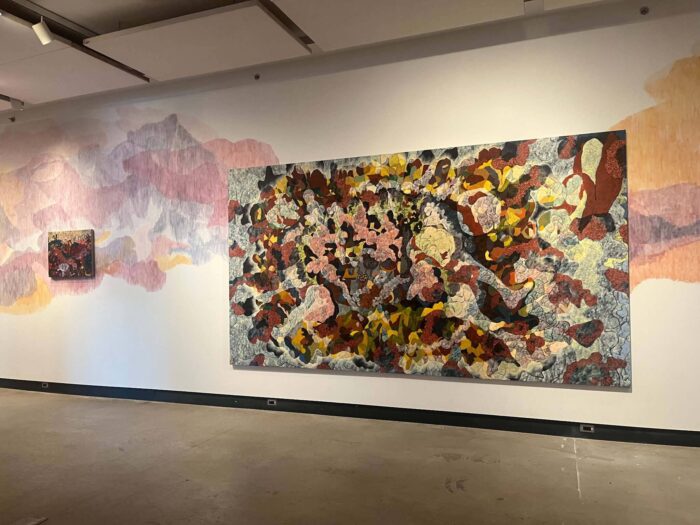
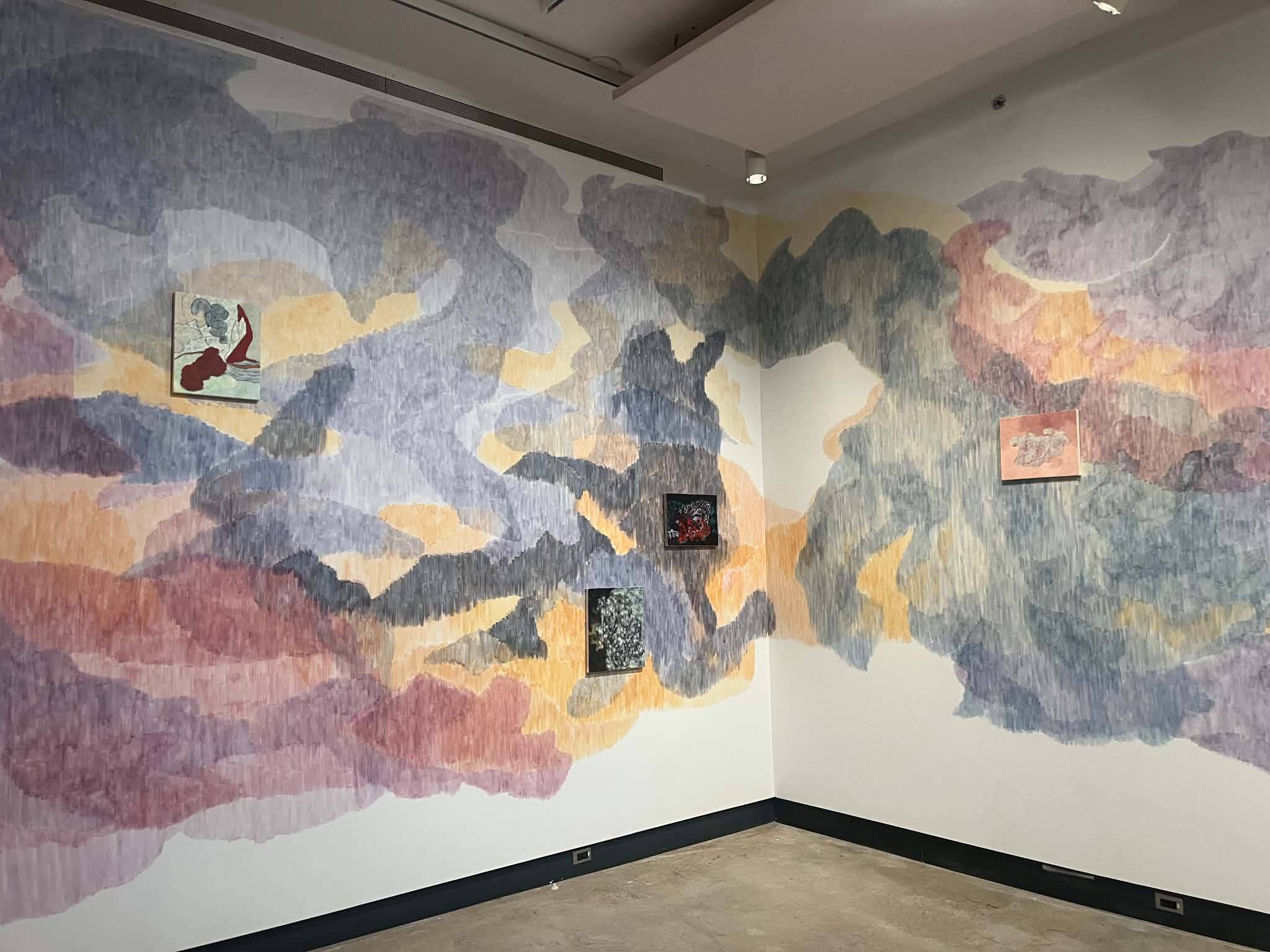
Derek Liddington’s exhibition The still cloud, in anger, in awe. is not so much a display of individual paintings as it is an environment defined by painting. This is appropriate when one considers the motivations – or perhaps, more exactly, the genesis of the artworks.
Allow me to inject some words from the exhibition statement to clarify this sentiment :
A central part of Derek’s practice is his use of studio residencies as a means of developing larger research projects. During the summer of 2026 he participated in the Banff Centre for the Arts Leighton Studio Residency program. This 6-week intensive studio research focused on the visual, formal, and narrative potential of clouds and the potential impossibility of representation given their shifting forms. These works come out of a larger interest in painting which focuses on the everyday gestures, movements, relationships, and decisions that build culture and, inevitably, define class. “The still cloud, in anger, in awe.” presents the results of Derek’s residency in a solo exhibition at Visual Arts Gallery. Taking the form of abstract painting and installation the works will weave together aesthetics associated with clouds, 20th century French abstraction, Ontario regionalism, and medieval painting.
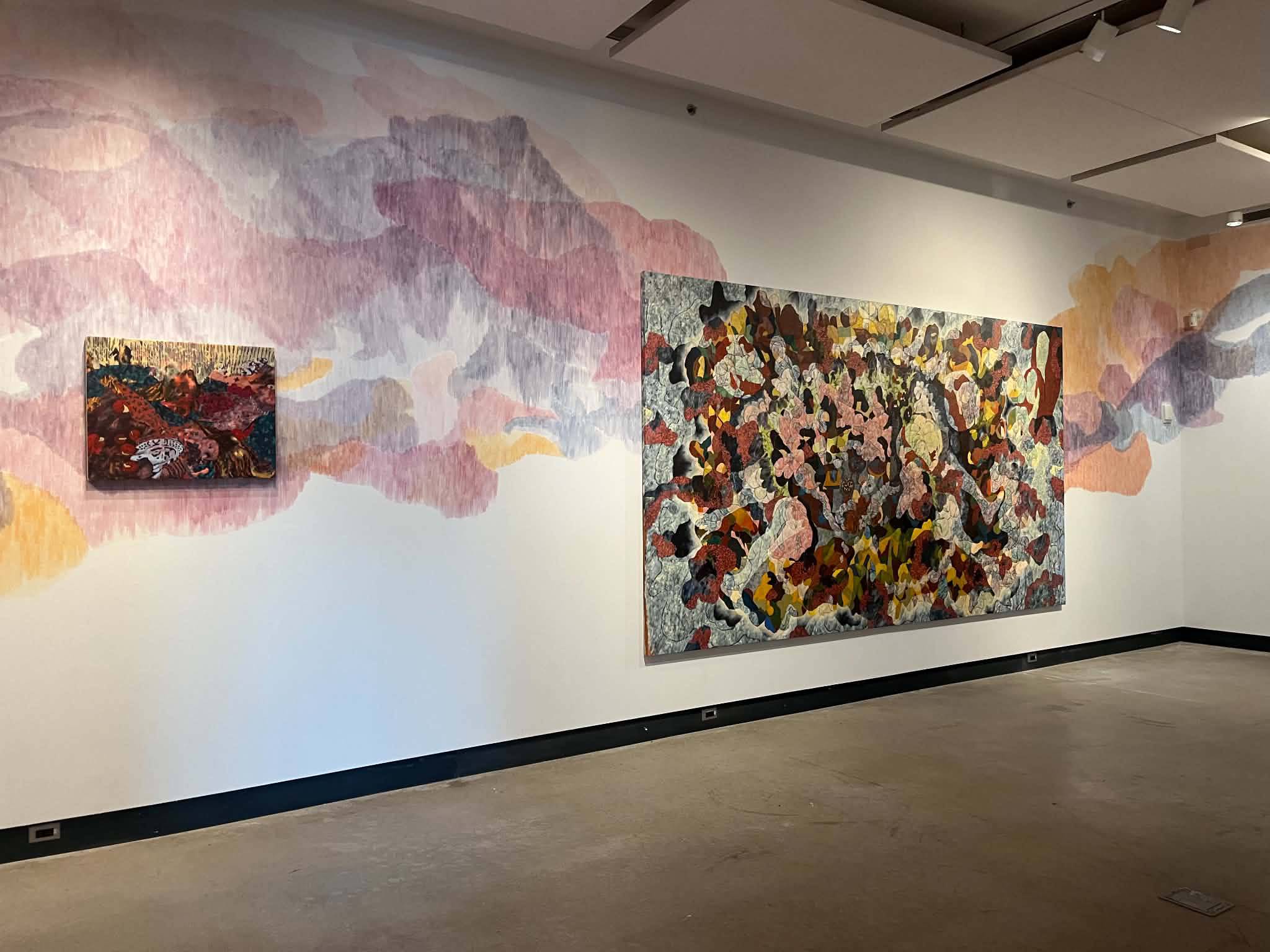
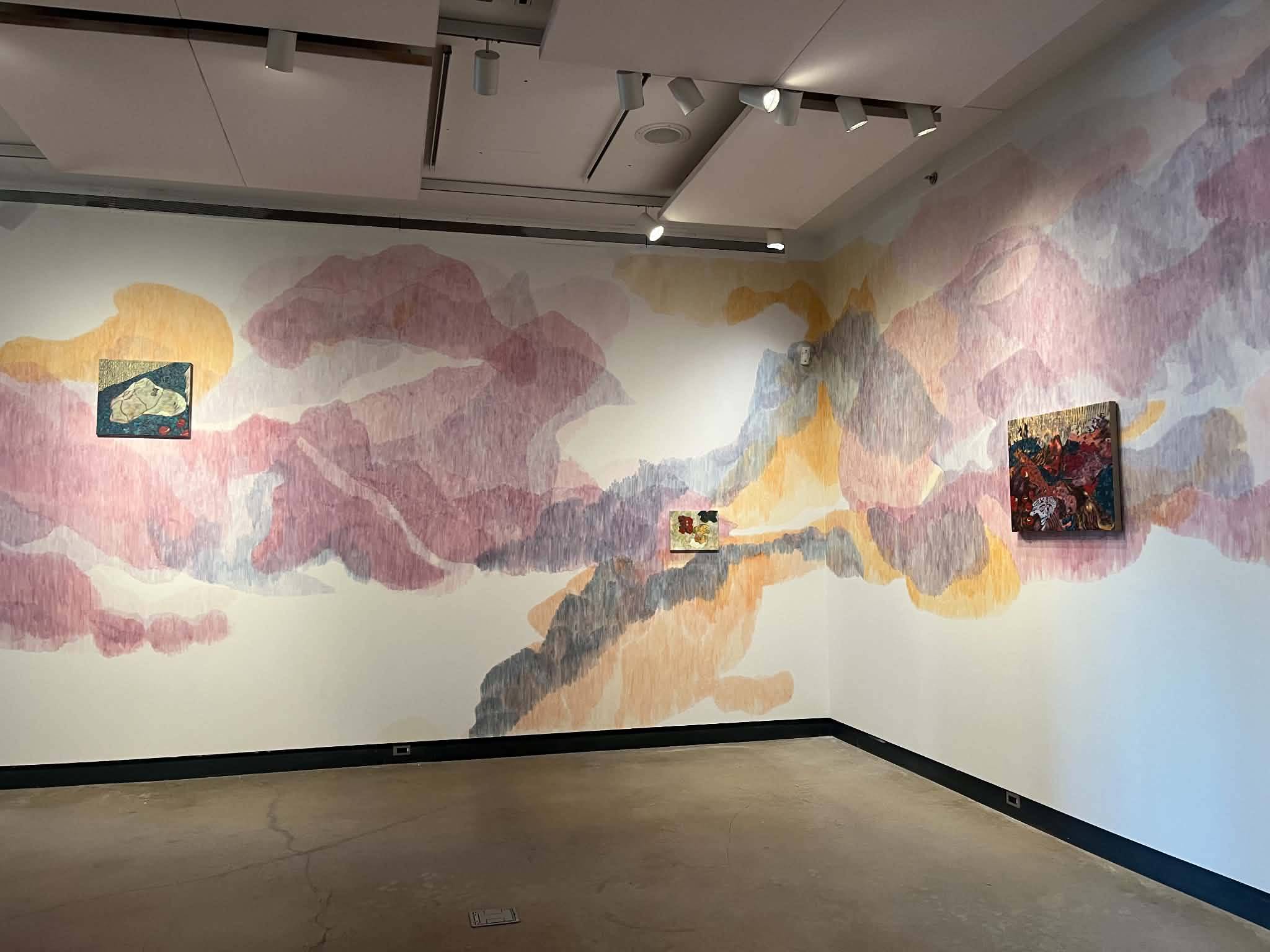
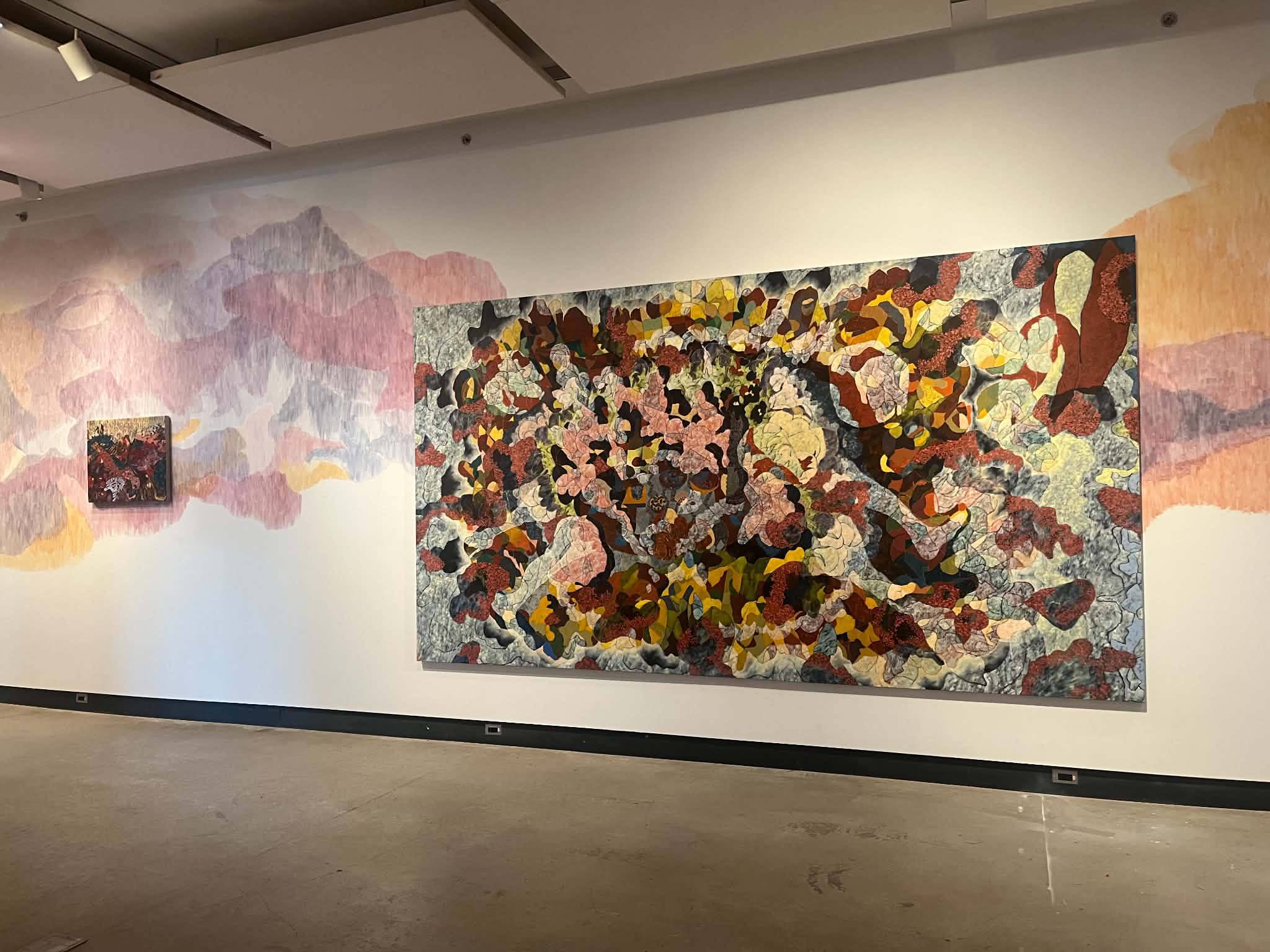
The individual works – that range in size from intimidating to intimate – act as punctuation marks in the show, as Liddington has painted the walls of the gallery with looping, swooping swathes of colour that both unite the works but also act as an ephemeral ‘stage’, if you will, to the more articulated painted moments in the show.
This loose, translucent and transparent – cloudy, if I may – use of colour and shape painted directly unto the walls of the VISA Gallery space allows for moments of visual rest, as the individual pieces are well worked, employing paint in a manner that is both delightfully visceral (such as how one work seems to be fabric or textured) or more gloppy and heavy, emphasizing a physicality of paint that contrasts to the light hand employed upon the gallery walls.
Again, Liddington has created an environment (like standing in a body of mist or cloud) that has moments of more articulated and actualized moments of painting.
When I visited this show I found that several pleasantly conflicting ideas came to mind. Or perhaps ‘contrasting’ is better term, as it aligns more with how we see what we want to, in clouds, and that reveals more about ourselves than the clouds, in a manner mimicking Jeane Randolph’s ideas of the amenable object in a gallery, where we, the viewer, define the majority of the meaning of an art object, with our own experiences.
The aforementioned Randolph’s assertion was one of the ideas that asserted itself. Another was the distance between title and object, as some of the titles are informative while others are perhaps too leading (but that echoes an idea of – if I may reference clouds again, which seems appropriate – of how one can see some clouds very clearly as one thing, while a person next to you sees something else entirely), and that inhibits the fine painterly aesthetic at play in Liddington’s artworks.
Some of the titles of the artworks – if you chose to read them, as the installation really needs no guiding words and stands well on its own – are delightfully evocative (Three flowers. Three clouds. You. Me and a shadow, or A dinner. An argument or It would never be as beautiful as it was) whereas others are too self conscious and a bit pretentious, deflecting the enjoyment of the painting (The cloud was trapped in a mountain held by trees as we watched in awe and wonder like that time I first saw Goya’s The Third of May and wept, not of joy, but for the loss I felt in never being able to paint like him, like that, with passion, impassioned, angry, in anger, in awe – which, interestingly, is the work in the show that most engaged me, with textures and delicate markmaking that engage and enthrall, without need of such loquacious language…).
But this is a featherlight criticism : too often contemporary art eschews a well made, considered object for a overtly verbose statement, and that is not the case here, at all. Some of the smaller works that you might not initially consider, due to the non traditional placement of artworks, will pull you in, if you give them time, and the painterly textures and scabby, choppy and frothy use of paint (all said as a compliment) will entice you.
I also considered Julian Bell’s book What Is Painting? Representation and Modern Art where the author offered the following gem (which is a touchstone for me, in considering painting) : ‘…there was no prior context to the painting itself. The viewer’s eyes would submit, and the painting would act.’
Standing in the gallery space, surrounded by Liddington’s visual meditations, considerations and iterations of ‘clouds’ I greatly enjoyed turning and moving, having specific elements of the installation catch and hold my eye, and then when turning again having another aspect of his works hold me, and pull me in closer.
Liddington has provided an environment that envelopes us, and one needs to stand amidst it and let your mind drift (like when considering clouds in the sky) and then simply move towards the moments and pieces that draw you to them.
The exhibition The still cloud, in anger, in awe. by Derek Liddington is on view until October 10, 2026, at the VISA in the Marilyn I. Walker School of Fine and Performing Arts (15 Artists’ Common). Gallery hours are Tuesday – Saturday, from 1:00 pm – 5:00 pm.
I also would like to thank Kosar Dakhilalian, as our conversation when visiting this exhibition directly contributed to this article and helped consolidate several ideas swirling in my head.